

-1.svg)









Construction is always evolving but recent years have brought dramatic shifts. Between economic cycles, federal incentives, workforce changes, and shifting demand for building types, staying ahead of financial reporting requirements has never been more critical for construction companies.
According to Sage Economics, from the start of 2021 through mid-2024, U.S. manufacturing construction spending surged by more than 210%, driven heavily by computer chip megaprojects. However, that momentum has started to cool. Overall manufacturing spending is now down about 3% from its peak in June 2024, and the chip segment has dropped about 12%. Still, manufacturing construction remains a powerhouse, accounting for roughly $1 in every $5 spent on nonresidential construction.
In contrast, inflation-adjusted spending on office buildings has plunged about 55% since its all-time high in February 2020 (Sage Economics), reaching levels not seen since the Great Recession. The data tracks broader trends which show more than half of college-educated workers worked from home in 2023. Office occupancy isn’t expected to return to pre-pandemic levels therefore a major rebound in office construction appears unlikely.
The construction labor market is also tightening. Industry job openings have dropped approximately 45% since peaking in December 2023 (Sage Economics). Among residential specialty trade contractors, employment has declined by 27,200 jobs since its September 2024 high.
At the same time, federal policy is driving both incentives and constraints. The One Big Beautiful Bill Act allows a 100% immediate deduction for qualified U.S. factory construction and improvements, provided the project begins between January 20, 2025, and December 31, 2028, and enters service by 2031.
Additionally, a June 2025 White House memo reinforced the use of Project Labor Agreements (PLAs) on large federal construction projects. While PLAs don’t technically require union labor, their provisions often make it difficult to use non-union contractors.
This matters because union membership in the construction industry has fallen significantly from nearly 1.2 million in 2000 to about 845,000 in 2024 (Sage Economics). This is partly due to growth in right-to-work states across the South and West.
Union and non-union contractors alike, face similar core risks but differ substantially in labor-re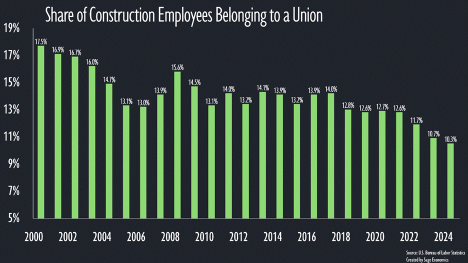 lated compliance and accounting considerations. Accurate financial reporting is essential for winning bids, securing financing, managing cash flow, and protecting your business. Audited financial statements are becoming the norm and not just for large corporations, but for local general contractors, subcontractors, and specialty trades.
Here are a few key areas auditors test and how they affect your business:
- Most contractors use percentage-of-completion accounting which recognizes revenue as work progresses rather than waiting until the job is done. If you overestimate progress ("front loading"), you might show profits that don’t exist which causes major problems later. Auditors verify your profits match reality.
- Auditors confirm whether your receivables are real and collectible. Uncollected invoices could turn into bad debt so auditors may flag slow-paying customers or overbilled work.
- They also check for unpaid bills, accrued expenses, and costs you might be underestimating. If you’re not capturing all your project costs (materials, labor, subs), your profit picture may be inaccurate. This could lead to poor decisions or even default risk.
- Auditors look at how you manage cash, payroll, and job costing. Weak internal processes can lead to fraud, misbilling, or tax issues. Auditors help ensure your systems are sound.
The biggest differences relate to labor, how it’s managed, tracked, and reported.
- Union Contractors
- Required labor costs due to union rates, benefits, and dues.
- Must comply with prevailing wage laws, collective bargaining agreements, and benefit plans (like pensions).
- Auditors check payroll reports, union agreements, and benefit liabilities.
- Non-Union Contractors
- More flexibility in setting wages and benefits.
- Fewer regulatory requirements but still must follow general labor and tax laws.
- Auditors focus on classifying workers correctly and ensuring benefits (if any) are properly recorded.
- If you are a union contractor, mistakes in payroll or benefit reporting can be costly and trigger penalties. If you are a non-union contractor, misclassifying workers or underreporting costs can hurt your bottom line or lead to compliance issues.
Whether you are union or non-union, here are issues auditor testing may uncover:
- Overstated revenue or profit (often from overestimating job progress)
- Understated payroll form misclassified workers or missing tax withholdings
- Missing or uncollectible receivables
- Underreported liabilities (like unpaid union dues or vendor invoices)
- Inadequate internal systems for tracking jobs, cash, or costs
Catching these matters early helps avoid major problems with the IRS, banks, bonding companies or worse, a failed project.
If you are thinking about getting your first audit or want to make your next one smoother, start by:
- Organizing your job schedules and cost-to-complete reports
- Cleaning up accounts receivable and payables
- Reviewing your union agreements or benefit plans
- Making sure your payroll system is accurate and compliant
Audits are not just compliance exercises, they are a valuable tool to strengthen financial health, build credibility, and drive long-term growth.
Still unsure what you need? Ask your 415 Group CPA, who can guide you on what’s required and how to get audit-ready.